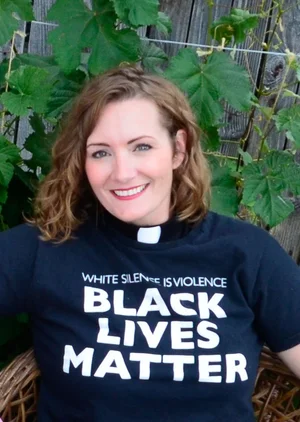
This blog post is adapted from a sermon preached by Rev. Dr. Jenny Whitcher at Community United Church of Christ - Boulder on July 12, 2026
Readings: Isaiah 55:10-13 (The Inclusive Bible) | Pleasure Activism: The Politics of Feeling Good, adrienne maree brown
Isaiah 55:10-13, The Inclusive Bible
For just as from the heavens
the rain and snow come down
and do not return there
till they have watered the earth,
making it fertile and fruitful,
giving seed to the sower and bread for food,
so will my word be
that goes forth from my mouth:
it will not return to me empty,
but will carry out my will,
achieving the end for which I sent it.
And you will go out joyfully,
and be led out in peace;
the mountains and hills before you
will break into cries of joy,
and all the trees in the countryside
will clap their hands.
The cypress will grow in place of the thorn bush,
the myrtle will replace the briers;
and they will stand as a memorial to Creator,
an everlasting sign never to be destroyed.”
Pleasure Activism: The Politics of Feeling Good, by adrienne maree brown
What is Pleasure Activism? Pleasure is a feeling of happy satisfaction and enjoyment. Activism consists of efforts to promote, impede, or direct social, political, economic, or environmental reform or stasis with the desire to make improvements in society. Pleasure activism is the work we do to reclaim our whole, happy, and satisfiable selves from the impacts, delusions, and limitations of oppression and/or supremacy…Pleasure activists believe that by tapping into the potential goodness in each of us we can generate justice and liberation, growing a healing abundance where we have been socialized to believe only scarcity exists….Ultimately, pleasure activism is us learning to make justice and liberation the most pleasurable experiences we can have on this planet.
This is as much for me as it is for you.
I've always been a pretty serious person, in terms of having a strong sense of injustice and a focus on purposeful action. I’ve longed to follow the way Jesus lived and to do so in community with others. I have my own traumas and I’m observant of the world around me, of reality of other people's pain, of the systems of oppression, greed, wealth, slavery, and exploitation that cause it.
However, rather than being defined by a lack of joy, I’m driven by intention and meaningful engagement.
Does that resonate with you?
But, the evil in our country and world, well, it sucks joy right out of me.
Does that resonate with you?
I need to be reminded to find joy in the work. Maybe you do too, because the world is heavy and it is getting heavier.

What the Rain Knows
Listen again to what Isaiah tells us:
For just as from the heavens the rain and snow come down and do not return there till they have watered the earth, making it fertile and fruitful, giving seed to the sower and bread for food, so will my word be that goes forth from my mouth: it will not return to me empty, but will carry out my will, achieving the end for which I sent it.
I want you to notice something about this image. Rain doesn't fall reluctantly. Snow doesn't melt with a sigh, dragging itself down the mountain out of a grim sense of obligation.
Water simply does what water does — it moves toward the earth, and the earth drinks, and something grows. There's no martyrdom in a rainstorm. There's no exhaustion in a snowmelt. There is only motion toward life.
Isaiah doesn't stop at "the word will accomplish its purpose." The work is not enough on its own.
The scripture goes on to say: “and you will go out joyfully, and be led out in peace; the mountains and hills before you will break into cries of joy, and all the trees in the countryside will clap their hands.”
This is not incidental imagery. Isaiah is telling an exiled, frightened, displaced people that the work of liberation — their return, their restoration, their whole terrifying, uncertain future — will be accompanied not by grim endurance but by joy so large the land itself cannot contain it.
The cypress will grow where the thornbush was. The myrtle will replace the briers. Something beautiful will stand where something painful used to be, and it will stand as a memorial — not to the suffering, but to the God who transformed pain with joy and abundance.
The myrtle (Hadassah) is a fragrant evergreen with glossy dark green leaves, white flowers that look like fuzzy starbursts fit for a Dr. Seuss book, and edible dark blue berries–indegenous in Palestine and Israel. The myrtle does not look like it belongs in the desert.
Myrtle thrives in harsh environments and low valleys—joy and fruitfulness within environments of pain and sorrow.
Isaiah is not naive about the hardship. Isaiah is naming a choice.
Pleasure as a Form of Resistance
adrienne maree brown names that same choice in different language. They write about pleasure activism — the work we do to reclaim our whole, happy, satisfiable selves from the impacts, delusions, and limitations of oppression and supremacy. They’re not talking about pleasure as an escape from justice work. They’re talking about pleasure as fuel for it. adrienne believes that by tapping into the goodness already inside us, we generate justice and liberation — that we grow abundance in places we've been trained to see only scarcity.
Ultimately, pleasure activism is us learning to make justice and liberation the most pleasurable experiences we can have on this planet.
I’ll say that again, because it will preach against every instinct a lot of us have. We have been formed — some of us by seminary, some of us by movement culture, some of us by our family systems — to believe that the more something matters, the more it should hurt.
Pleasure activism is us learning to make justice and liberation the most pleasurable experiences we can have on this planet.
We’ve been taught that solemnity is the price of admission to serious work.
I don't believe that anymore. And Isaiah doesn't either. Mountains break into cries of joy on the way to liberation, not after it's safely over.
Yes, there is a place for seriousness. And also, the work of justice-making and liberation requires joy all along the way.

Photo by Colin Lloyd on Unsplash
What We Choose
We don't get to choose whether the work in front of us is hard. We don't get to choose whether it's risky, whether it's frightening, whether it makes us angry or grief-stricken before we even get out of bed.
But we do get to choose how we approach it.
We can choose to bring our creativity, our imagination, our joy — especially now, in this season when so much is being asked of us.
And here's what I've noticed, over and over, when we make that choice, when we choose joy:
The work actually gets done.
The work gets done faster.
We waste less time — less time stuck in dread, less time paralyzed by fear, less time spinning in the kind of seriousness that looks like commitment, but is actually just exhaustion and uncertainty wearing a fancy coat.
And most importantly: Relationships build joy. And joy in relationships builds courage. You cannot sustain the kind of courage this moment requires all by yourself, gritting your teeth in isolation. You can only sustain it in community — and community is built, brick by brick, out of shared joy as much as shared struggle.
Let me tell you what I mean.
Fifty Clergy and a Buzz in the Air
We had three weeks to plan the "Clergy Protect Our Vote and Democracy" press conference at the Colorado State Capitol that happened last Tuesday. And I spent the week right before the press conference out of state, on a long-ago planned vacation, trusting my co-organizers to continue the work so that I could come back and continue running with them for the last 48 hours. And I did not look at my email, I chose joy that week of vacation with my family and friends. This is one form of finding joy in the work–taking time for restoration, even when it turns out to be inconvenient. Joy is also in the relationships of trust, where we step up for one another whether it is due to taking care of our children or parents, illness, time away, or the unexpectedness of life.
On July 7th, fifty clergy showed up. We held the second-largest press conference in the country that day, as part of a coordinated national day of action across 15 media markets and 9 states. Two media outlets came to our Denver press conference. And if you have ever organized a public action at the Colorado State Capitol, you know — two media outlets is good.
But here's what actually mattered, and it wasn't the numbers.
What mattered was the loving joy with which everyone showed up.
The amazing speakers.
The clergy standing shoulder to shoulder.
The staff and volunteers of our campaign partner Together Colorado, who agreed to partner on the press conference just two weeks ahead and in a season where their staff were cycling through national trainings and vacation.
The reporters whose hearts were in it. One reporter told me after the press conference, “I’m so glad to be here, but I’m so sad that it has come to this, that things are so bad that you have to do this.”
The volunteer marshals and medics — people who came from partner organizations, and who aren't religious themselves. Some of whom have been genuinely hurt by the church in their lives, but who showed up for us anyway because they want to see spiritual and faith leaders stepping up right now. They want us, the Church, to speak out and take action as a moral authority against injustice, harm, and violence.
There was a buzz in that crowd. A warmth. A sense of "we are comrades in this," even though many of us had just met that morning.
We know that we are heading into a difficult season, and we are preparing for poll chaplaincy, voting escorts, vigils held while ballots are counted, and public pressure from spiritual and faith leaders to confirm and seat all elected officials. All of it in service of everyone's right to vote and to have the people they elect actually seated in office.
The Threats Are Real
We know the threats are not abstract.
The regime is still trying to use threats and coercion to end mail-in voting nationally after courts rejected this violation of the US Constitution and federal law. In Colorado, 92% of us voted by mail in the 2024 general election, and as a blue state, we are a target.
The regime is trying to pass the federal Safeguard American Voter Eligibility or SAVE Act, which would increase requirements for voters to prove citizenship, which is designed to stop women, Black and Brown people, lower income people, and people in rural communities from exercising their constitutional right to vote.
The regime has threatened to send armed federal agents to polling places, an intimidation tactic that would keep targeted people from voting.
The regime is demanding state voter rolls, which is a violation of the law. Some states like Colorado are saying no, and others have complied putting their registered voters at risk to federal oversight and voter purges. We already know from all their other racially-charged actions that they will be targeting “non-white” sounding names.
Last fall, Representative Adelita Grijalva of Arizona was not sworn in or seated in the House of Representatives for 7 weeks after her election, because House Speaker Mike Johnson refused to administer the oath of office. The 7-week delay set a record for the longest time a member-elect had been kept from being sworn in. The House Speaker was trying to dodge a vote on releasing the Epstein files, knowing Representative Grijalva would vote in support of the files being released. It took immense public pressure to get Mike Johnson to finally swear in Representative Grijalva.
What do we think they will do to secure their power for longer? I think it is likely that all options are on the table and we need to be prepared.
In June, The FBI raided the Ohio Organizing Collaborative’s offices and seized documents and computer files. Federal agents visited the homes of staff, volunteers, and partners connected to their work.
The Ohio Organizing Collaborative is a nonpartisan nonprofit whose mission is to build transformative relational power with everyday Ohioans for statewide social, racial, and economic justice.
To date the Ohio Organizing Collaborative has registered more than 600,000 people to vote, a majority of which are people of color.
And Ohio is expected to have highly contested races for governor and US Senate this November.
You do not need me to draw the line for you between those two facts.
Allegations of voter registration fraud are typically investigated by states and involve people working for groups that pay for sign-ups. The Ohio Organizing Collaborative is not one of those groups.
The Ohio Organizing Collaborative is part of the national Faith In Action network of local, non-partisan, Faith-based organizing. And the Ohio Organizing Collaborative is a sister organization to our partner Together Colorado, and ISAIAH in Minnesota.
Finding Joy In The Work
I’m one of the co-founders and organizers of the Colorado Clergy Alliance and we are working in partnership with Together Colorado and a national clergy campaign called Faith In Us that is organizing to protect everyone’s right to vote free from intimidation, our right to a free and fair election, and our right to have our elected officials confirmed immediately into their positions.
The Faith In Us campaign is being led by faith leaders and organizers from Faith In Action network member ISAIAH in Minnesota, because they experienced what the federal government will do to communities during the ICE surge in Minneapolis, and they chose to take a national lead to help us all protect our vote and our democracy together.
This is just one story, there are unfortunately a lot of stories, and some far more severe. And there is more coming.
The federal government has already shown us the lengths it will go to to prevent a free and fair election.
This is the landscape. It is genuinely frightening. And still — fifty clergy showed up with loving joy to kick off the Clergy Protect Our Vote campaign.
That is not denial. That is not spiritual bypassing. That is a choice.
We are choosing to build something that people want to be part of, rather than something people dutifully endure.
And because we chose joy and not fear, the press conference got built in three weeks by a team that included someone who was out of state for one of those weeks and a community partner that joined just two weeks out.
Because we chose joy and not fear, strangers from different spiritual and faith traditions and none at all found each other fast, and trusted each other faster than trust usually moves.
Because we chose joy and not fear, the relationships formed that week are exactly the relationships we are going to need when the work gets harder — and it will get harder, because Ohio's story is not the last story like it we will endure.
The Cypress in Place of the Thornbush
So this is my invitation to myself, and to you.
The work in front of us — protecting the vote, protecting our neighbors, standing between the people who are targeted and the systems built to target them — this work is not going to get lighter. But we get to decide whether we carry it like a burden or whether we carry it like the rain carries itself toward the earth: moving, purposeful, unafraid to make something grow along the way, and bending sunlight into vibrant rainbows–joyful promises of life and liberation.
Isaiah promises us that the cypress will grow in place of the thornbush. Thornbushes are real, briers are real, the FBI raiding a nonpartisan community organization doing voter registration is real; immigrant concentration camps are real; unending war and US-Israeli genocide of Palestinians are real; severe, death-dealing cuts to ours and the world’s social safety net, regulatory departments, and environmental protections and monitors are real.
God’s transformation and restoration of the earth will grow not instead of hardship, but in place of it. Over time, something beautiful will stand as a memorial to what is possible when we don’t let fear alone drive our work.
The mountains are going to break into cries of joy before this is over. The trees are going to clap. I choose to believe that, and I choose to act like it's true, because acting like it's true is exactly what makes it true faster.
So find your fifty clergy. Find your community partners, Find your marshals and medics who show up even when the church has hurt them. Find the joy that gets the work done, gets it done faster, saves you from wasting your one precious life in dread, and builds the relationships that will carry your courage when your own runs low.
Go out joyfully. Be led out in peace. And may we all be loving and joyful participants in God’s transformation. Amen.
For Reflection: Think of a time you found joy in the work. What specifically brought you joy?