Save us now! A Palm Sunday Protest
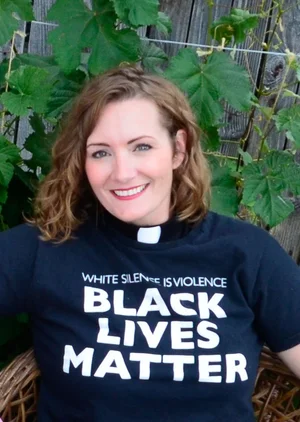
Sermon by Rev. Dr. Jenny Whitcher, Minister of Prophetic Formation at Juniper Formation, preached at Park Hill Congregational UCC in Denver, CO.
Whenever empire stages a parade, it wants to be seen.
It wants polished armor, synchronized steps, banners held high, weapons gleaming in the sun. It wants the kind of order that makes people believe resistance is futile.
Because if people can imagine something different, empire begins to crack.
So empire rides in on war horses.
While the rulers of empire rode into Jerusalem through the gates on the other side of the city on war horses—symbols of conquest, intimidation, and domination—Jesus chose a donkey.
Not because it’s quaint. Not because it’s humble in a sentimental way. But because it is a direct counter-symbol.
It says: This is not how power has to work.
And the people understand this.
They spread cloaks on the road—not just as a gesture of honor, but as an act of participation. They are not spectators. They are joining the movement. They are putting their own bodies, their own belongings, into the path of this alternative vision.
And then they cry out: “Hosanna!”
Which is not polite praise.
It is a demand. “Save us now.”
Not someday. Not in heaven. Not in abstraction.
Now.
Save us from what is crushing us. Save us from systems that grind people down. Save us from the normalization of violence.
Hosanna is what oppressed people say when they’ve run out of patience for waiting.
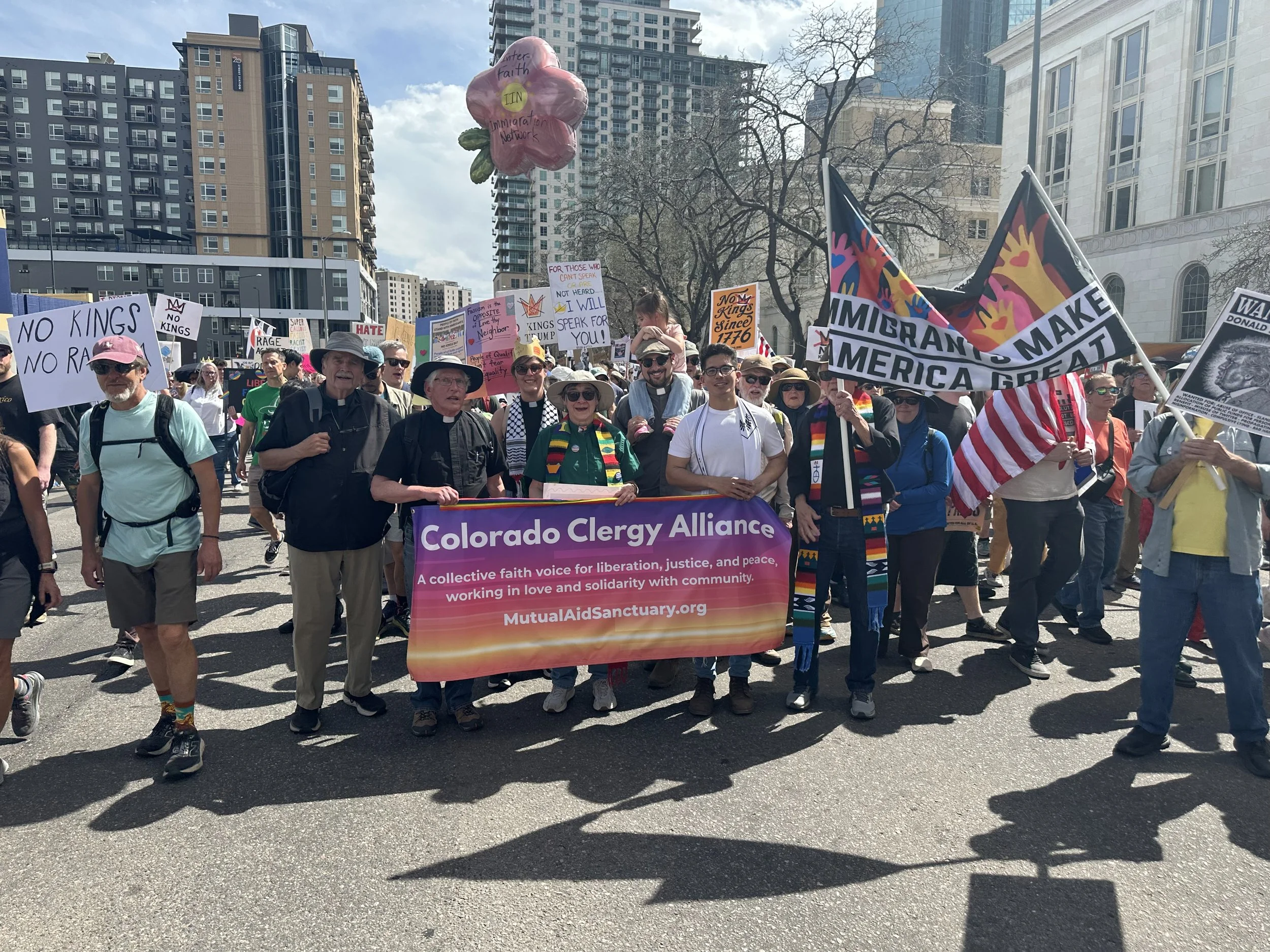
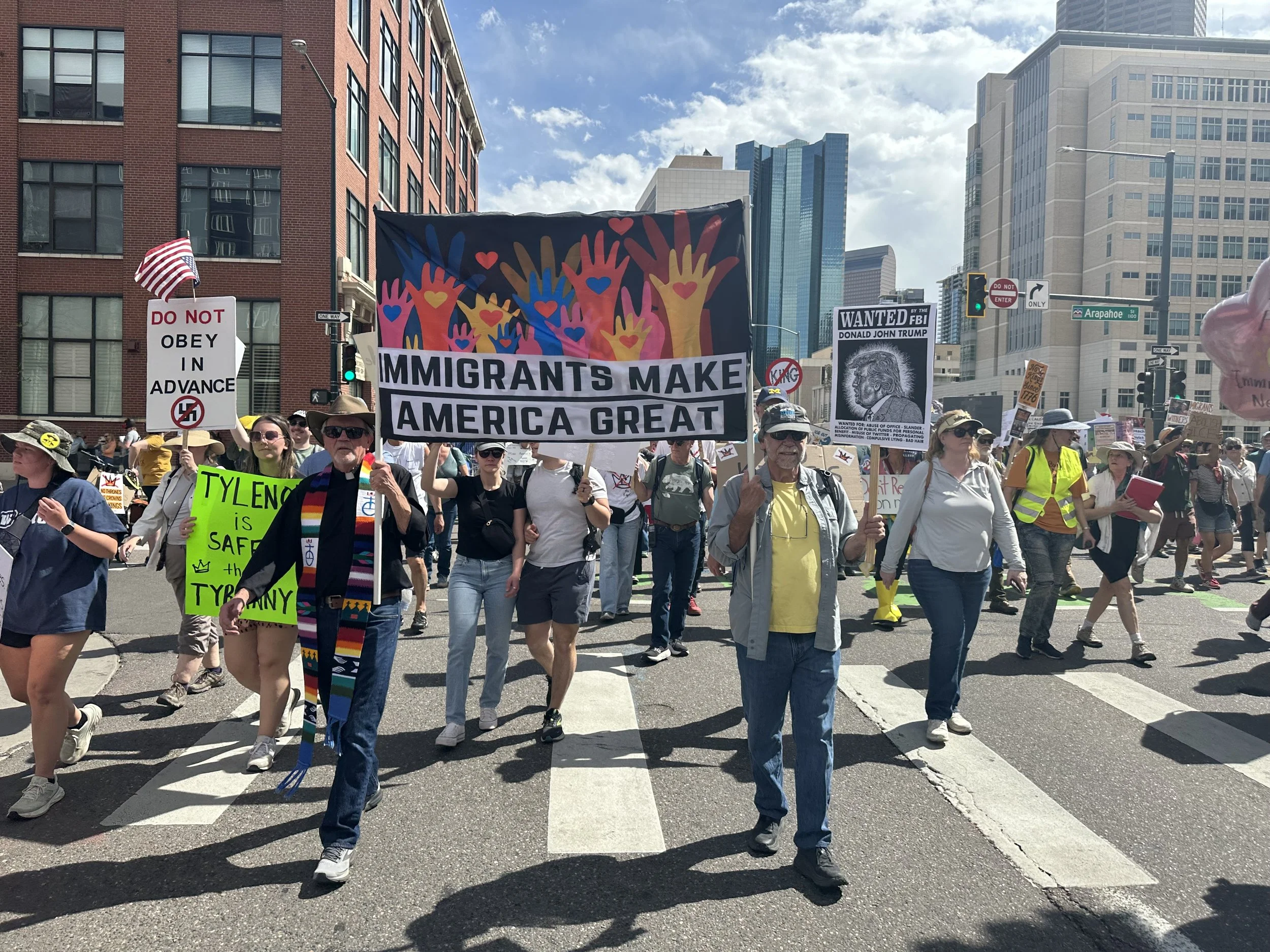
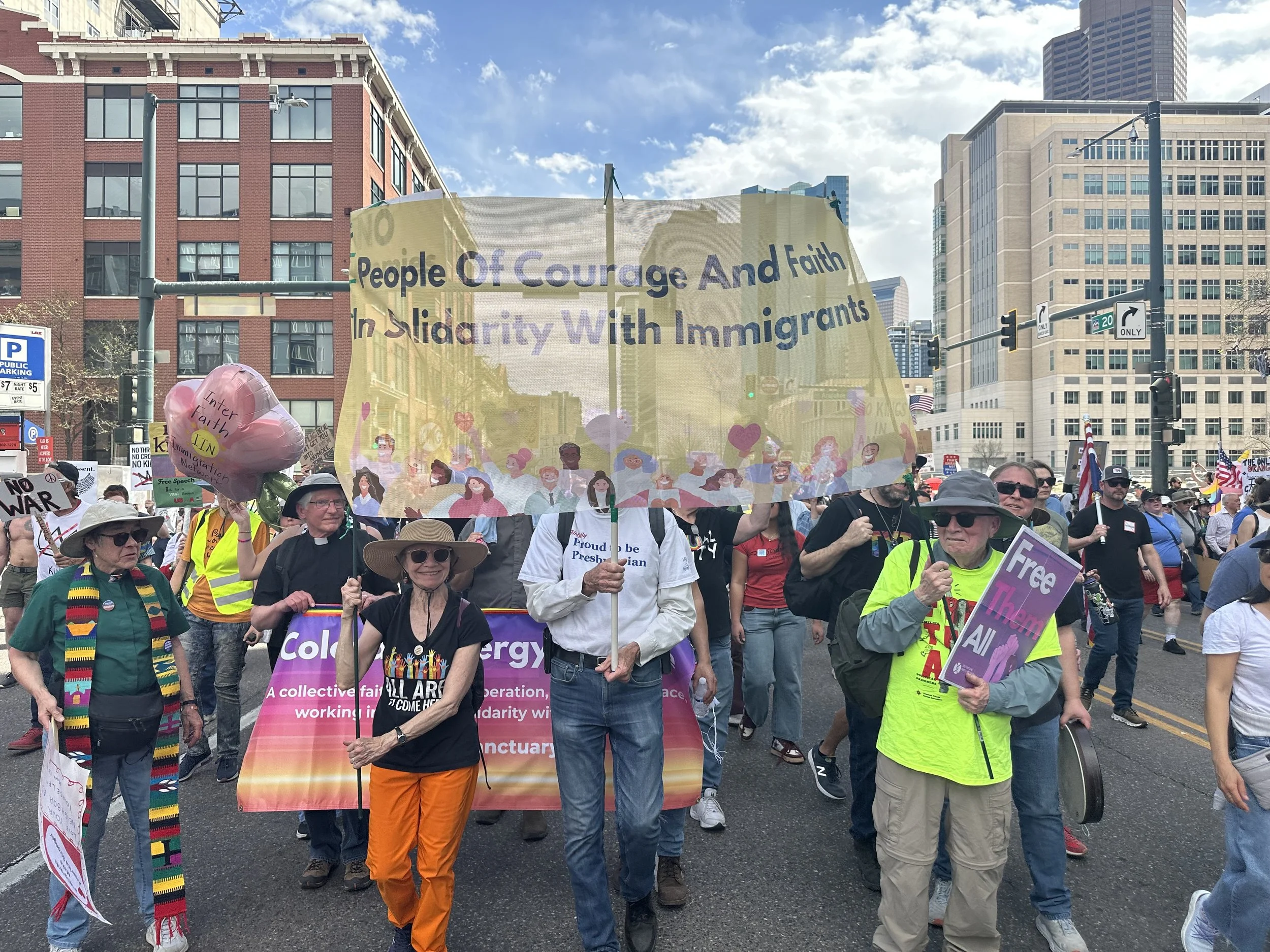
Yesterday at the No Kings Protest, an estimated 8 million people across the country turned out, and 70,000 people showed up in Denver. We marched 3 miles around the city singing protest songs, chanting, meeting neighbors. 70,000 people is almost 10% of the population of the city of Denver. And while we know that protests draw people from outside of the city, these are historic turnout numbers across the country in small towns and major cities.
Harvard political scientist Erica Chenoweth has done research on over 300 nonviolent and violent movements between 1900 and 2006. Her research indicates that nonviolent campaigns which manage to achieve the active, sustained participation of 3.5% of the population have never failed to achieve their goals—whether that is regime change or territorial liberation.
3.5% is not about a one-day protest, it is about sustained, continuous organizing and campaigns.
3.5% is not a magic number either. Most successful nonviolent movements achieved their goals with less than 3.5% of the population. 3.5% is simply where 100% of sustained nonviolent campaigns are successful.
Protests in and of themselves do not create social change; ongoing relationship building, organizing, strategy, tactics, and sacrifice create social change.
Protests do not create solidarity; ongoing relationships and sustained collaboration create solidarity.
So what is the point of protesting?
Protests are a spiritual gathering, a place where we come to see and be seen. A place where we build courage together. A place of blessing each other into being. A place where we know deep in our bodies that we are not alone. Some might say that protest is a form of church.
Yesterday, I wore my clergy collar and stole with other clergy from the Colorado Clergy Alliance and lay leaders from the Interfaith Immigration Network, including some members of this church!
Throughout the afternoon other protestors from outside of our circles came up to me and with courage in their voice that tried to cover their emotion said,
“I just want to tell you how important it is that you are here today. That all of you are here today. Thank you for showing up.”
“We protested behind you through the whole march and listened to you sing, and it was beautiful, and we were so grateful to be behind you. Thank you for being here.”
And some just came to walk beside me for a bit, getting close enough so that I would notice them, say hello, read their sign, offer them encouragement, and then they moved on. A simple blessing that they were doing the right thing, that what they had to say mattered.
A queer couple approached with a nervous and gregarious giggle, and with courage asked, “If male priests are called father, what do we call you?”
Their question was one of inclusion. In a patriarchal system of he and hims, what are your pronouns? We want to include you. How do we do that?
What a remarkable moment of meeting each other on the street, me with my rainbow stole and trans flag pin, and they with their own desire to include the feminine embodiment of church leadership that is different from what they’ve known.
Jesus knew that protests are a spiritual gathering, a place where we come to see and be seen. A place where we build courage together. A place of blessing each other into being. A place where we know deep in our bodies that we are not alone.
He knew as he headed towards his death that the people needed each other.
And so, Jesus confronted the domination of empire.
Jesus did not avoid it.
Did not soften it.
Did not spiritualize it away.
Jesus staged a counter-procession.
Because while power performs control, Jesus embodies truth.
And I want to ask you:
When you look at the world right now, just the past few weeks,
Where have you seen power used in ways that harm rather than heal?
Don’t rush past that.
This is where this Palm Sunday story comes alive.
And the people cry out:
Hosanna.
Save us now.
This cry is not ancient history. It is the cry of all oppressed people.
It sounds like racially profiled Black and brown-skinned people saying, “I haven’t done anything wrong.” Because they haven’t.
It sounds like trans teenagers asking lawmakers, “Why are you targeting us?” Because there's nothing wrong with them.
It sounds like communities facing rising costs, housing insecurity, asking, “How can I afford to take care of myself, my family, my parents, each other?” Because they can’t. And being told to just endure it quietly.
Hosanna.
Save us now.
This is the sound of Palm Sunday—happening again almost 2,000 years later.
And still—many stand at the edges.
Watching.
Careful.
Because we know the cost of stepping in.
We’ve seen it.
We’ve seen people lose jobs for speaking out.
We’ve seen protesters arrested and charged as terrorists
We’ve seen public pressure to conform—to not say too much, not risk too much, not disrupt too much.
We’ve heard the message, loud and clear:
Stay in line.
Stay quiet.
Stay manageable.
And when the Pharisees admonish Jesus, “Teacher, rebuke your disciples,” that is exactly what they mean:
“Make this manageable.”
“Follow the executive order.”
“Comply with authority—even when it overreaches. Even when it is unconstitutional.”
“Trust the system—even when it is failing people—killing people.”
“Jesus, make this less disruptive.”
Because disruption is dangerous.
Disruption reveals too much.
Disruption exposes how fragile unjust systems and leaders really are.
It shows that what we call “order” is often injustice that has gone unchallenged long enough to feel normal.
And we are seeing that right now.
We are seeing political leaders testing the limits of power—issuing sweeping directives, obliterating legal boundaries, daring institutions to resist.
We are seeing courts, universities, organizations, and the Church wrestling with whether they will comply or stand firm.
We are seeing voting rights, bodily autonomy, and freedom of speech disappear.
This is not abstract.
This is happening in real time, and it has been happening for a long time.
And into this tension, Jesus says:
“If they keep silent, the stones will cry out.”
But we are not keeping silent. The disciples are crying out,
Through protestors forcing Palantir to move its headquarters out of Colorado through a sustained, multi-year campaign of direct action and public pressure over Palantir’s work in automating “kill chains” and aiding immigration surveillance, and Palantir’s contracts with ICE and the Israeli military
The disciples are crying out,
Through 3,800 striking UFCW Union Local 7 workers, who are mostly immigrants, from the Greeley, CO, Swift Beef Company meatpacking plant. 99% of union members voted to strike against unsafe and abusive conditions, and wages that don’t keep up with inflation. Workers are entering their third week of the walkout at one of our nation’s largest meatpacking plants owned by JBS, the world’s largest meatpacking company with a market capitalization, or worth, of $17 billion. These immigrant workers are leading the first US-meatpacking plant strike in 40 years, in these ICE-filled conditions.
The disciples are crying out,
Through the declaration of a stage 1 drought in Denver—part of the continuous megadrought since 2000 due to global warming. Effective immediately, Denver residents should aim to reduce water consumption by 20%. Snowpack levels from Denver’s two primary watersheds, the Colorado River Basin and the South Platte River Basin, which indicate how much water we can expect to melt and enter reservoirs this spring are both the worst on record, at 55% and 42% of normal levels respectively.
The disciples are crying out,
Through the American Medical Association, the largest physician organization in the United States, who just reaffirmed and spoke into the Congressional Record their position that evidence-based gender-affirming care is medically necessary, and gender-affirming care for trans minors, including surgeries, is medically sound—and that access to this life-saving care should not be impeded.
Truth is not waiting politely anymore.
It is breaking through.
So I want to ask you:
Where do you hear the disciples and the stones crying out right now?
And maybe harder:
Where have you been tempted to look away?
Because Palm Sunday will not let us stay neutral.
Neutrality is not calm. Neutrality is not safe.
Neutrality is complicity dressed as caution.
There is a woman at the edge of the crowd outside of Jerusalem and she knows this.
She feels the risk.
Because stepping forward means being known.
And being known means being accountable.
So let me ask you:
What feels at risk for you, right now, if you were to step more fully into truth?
Your comfort?
Your relationships?
Your reputation?
Your safety?
Your kids?
Your money?
Yes.
That’s real. Those are real risks.
And that, beloved, is why this all matters.
And still—she steps forward.
Not because it is safe.
But because something in her knows:
There are moments when staying silent costs more than speaking up.
So she lays down her cloak.
And now the question turns to us:
What are we still holding onto?
What fear keeps us compliant?
What are we being invited to lay down—not someday, but right now?
Because this road leads to the cross.
It always has.
Speaking truth in the face of power has never been without consequence.
But it is also the only road that leads to resurrection and liberation.
And that road is cloaked in the participation and the sacrifices of the many. But you are not alone.
That road is widened and the hills flattened when we join each other in the revolution of the dismantling of systems of domination and empire.
That road is built on our faith in God, our faith in each other, and our faith that there is another way.
We don’t have to live like this, with all this violence, hate, supremacy, and oppression.
There is a different way of love, of liberation, and peace.
Stepping out and being known is also how we build courage, strength, solidarity, and community that can change the world.
So let me leave you with this:
In the world as it is right now—not abstract, not theoretical—
What would it look like for you to follow Jesus publicly?
Not just in belief.
But in courage.
Palm Sunday is happening again.
Not in memory—but in movement.
In protests.
In cries for justice.
In disruptions that make people uncomfortable.
In ordinary people deciding they will no longer stay at the edge.
Hosanna is rising. People are saying “save us” from the United States. Save us from ourselves.
Hosanna is rising,
From Cuba plunged into severe economic crisis, power grid failures, and limited food supply due to a US oil blockade and economic sanctions.
From Palestine where the US has sent $21 billion in military aid and diplomatic cover for the US-Israeli genocide.
From Yemen on the brink of famine from US aid freezes.
From Sudan experiencing one of the world’s largest humanitarian crises with millions displaced, and conflict exacerbated by US sanctions.
From Haiti experiencing severe food insecurity and a displacement crisis due to US intervention.
From the children of Iran to the children of detained and deported immigrants in Aurora and Northeast and Southwest Denver.
From transgender youth, whose gender-affirming care was suspended by Children’s Hospital and Denver Health because of the regime’s orders.
From thousands of women forced to travel to Colorado for reproductive healthcare, because we worked to make reproductive healthcare and abortion a constitutional right in Colorado, while women in four neighboring states with near-total abortion bans have become medical refugees, or otherwise, they double their risk of death because their states have up to a 62% higher maternal mortality rate.
Save us from ourselves.
Save us now.
Not later.
Now.
Hosanna is still rising.
From the streets.
From the margins.
From deep within us.
The procession continues.
The crowd still cries out.
And Jesus answers with thunder:
“If they keep silent, the stones will cry out.”
The stones.
The ones beneath your feet.
The ones that have watched empires rise and fall.
The ones that have absorbed blood, tears, prayers, and protest.
Even they cannot hold this in forever.
Because truth does not disappear when it is suppressed.
It ferments.
It groans.
It waits.
And then it erupts.
So may we be a people who don’t just wave palms from a distance.
May we be a people who step into the road.
Who risk participation.
Who let our worship become resistance, and our faith become embodied justice.
May we have the courage, like the woman at the edge of the road, to kneel down…
and lay something of ourselves in the path of love.
Hosanna.
Save us now.
Amen.