This is part of an ongoing series as we prepare for July 4th, 2026. We're sharing new posts weekly leading up to the 4th.
Rev. Allyson Sawtell's liturgical collection frames the work of this season around three essential spiritual movements. These are not stages to pass through but postures to hold simultaneously — and together, they constitute what it means to gather as a people of faith in summer 2026.
I
Wonder & Joy as Resistance
Choosing delight — in a purple flower, a moist winter soil, a dog's faithfulness — is not escapism. It is a declaration that the powers of cruelty and diminishment do not have the final word. Sawtell's "Claiming Joy and Gratitude" ritual invites congregants to name specifically what they love. Read aloud as a prayer, these become both testimony and defiance.
II
Remembering the Full Story
The Prayer for Remembering names exactly what we are told to forget: slavery's horrors, indigenous genocide, the systemic forces that still shackle communities. To remember in worship is to practice what the Administration forbids. As the litany puts it: "O God of history, free us from fear, denial, division, despair. Help us all face hard truths."
III
Faithful Resistance for the Long Haul
Sawtell's reflection on Moses is perhaps the most honest piece in the collection: we may not live to see the promised land. Courageous curiosity — turning aside from the worn path, asking "what if?" — is itself the point. The burning bush is always holy ground, whether or not we cross the Jordan. This includes new words by Dr. Amanda Udis-Kessler for the songs “America the Beautiful: A Vision,” and “I Love This Land,” set to Finlandia.
Liturgical Resources from Rev. Allyson Sawtell's Collection
The following liturgy is drawn directly from Rev. Sawtell's We Tell a Different Story PDF (shared with you for your use under Creative Commons, attribution required, noncommercial use). These are not summaries — they are the actual words, ready for your bulletin.
Call to Worship
This gathering liturgy holds the tension of wonder and uncertainty that defines this moment. It can open any Sunday service from now through July 4th.
Call to Worship — Leader led, Congregation responsive
Leader: We gather and wonder: what will the world be like years from
now? Next week? Tomorrow? What will this community, and
each of us, be like? Things change so weirdly and rapidly! Where
is God, the holy one?
All: We gather and we wonder.
Leader: And, we gather in wonder: at the goodness of others. At the
beauty all around us, in nature, the arts, other people. At our
dogs, cats, parakeets — animal friends who love us and comfort
Us.
All: We gather in wonder: at communities that come together and do
the work of justice, inclusion, peace. At people who don't stop
hoping. At laughter and joy.
Leader: We gather, and wonder: we fear, we keep moving, we pray, we
question, we celebrate. Together, in this wonder-ful community!
All: For wonder of all sorts, thanks be to God!
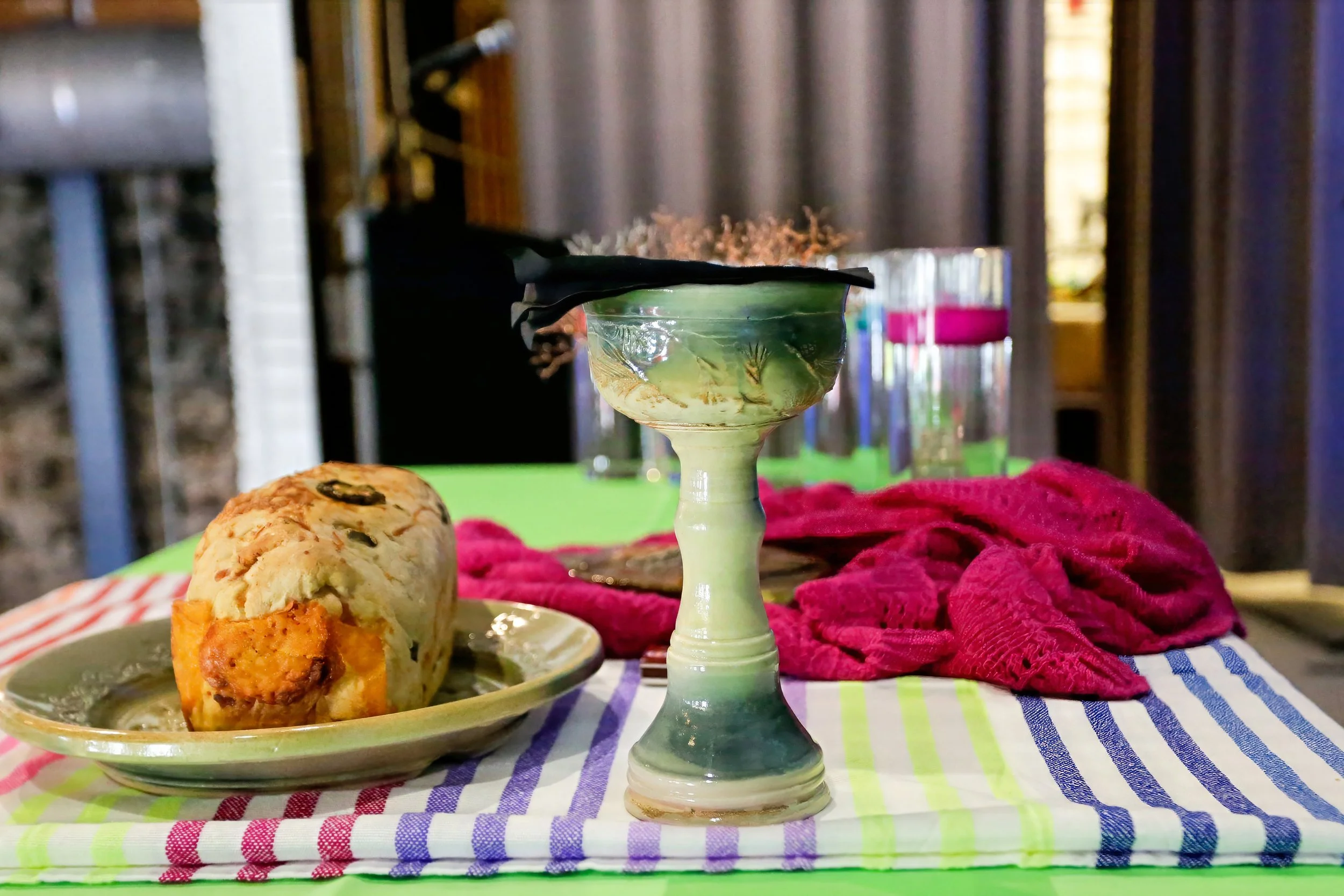
Photo by Juniper Formation staff
The Communion Litany: "Remember Me!"
This is the heart of the collection. Rev. Sawtell frames the Eucharist itself as an act of resistance: Christ's plea "Remember me" is heard now in every erased community, every disappeared history, every species driven to extinction. This litany replaces the traditional post-Communion prayer and can be used as a standalone responsive reading even in non-sacramental traditions.
Litany of Remembrance — In Place of the Prayer after Communion
Leader: The cry of Christ is in the cry of Creation:
People: Remember me!
Leader: The cry of Christ is the cry of those people, places, and histories
our leaders want to erase:
People: Remember me!
Leader: In the cries of those killed by ICE agents or dying held in illegal
detention, never making the evening news:
People: Remember me!
Leader: All your beloved LGBTQ+ children, threatened and denied the
fullness of who they are:
People: Remember me!
Leader: Species driven to and over the brink of extinction:
People: Remember me!
Leader: May we remember not only from the safety of our own homes
and houses of worship, but also on the marches and protests —
in the libraries — in the classrooms and on the School Boards —
in the national parks:
People: Remember me!
Leader: By our actions and lives, our relationships and priorities:
People: Remember me!
Leader: When it is awkward or downright risky to do so:
People: Remember me!
Leader: When you don't see the point of resistance, are discouraged, so
afraid, and ready to give up:
People: Remember me!
Leader: And in all of it, truly the Bread of Life, the Cup of Love, and the
power of this community of faith, will fill you and nourish you.
People: We will remember!
All: Amen!
A Prayer for Remembering
This prayer can follow a time of naming specific erased histories — the Tulsa Race Massacre, the Trail of Tears, the erasure of LGBTQ+ people from public life. It speaks directly to the God who has never prioritized a nation's comfort over its accountability.
Prayer — Read by Leader or in Unison
Intro: We're told some pieces of our nation's history are too hard for
some to hear. We're told some will make people uncomfortable,
will make our country look bad. We're told to forget them, to
believe they are twisted realities, exaggerated stories. We're told
it's wrong to remember them, to mention them, to teach them.
Let us pray.
Leader: O God of the prophets, who has been known to frequently
trouble the untroubled — when have you ever worried about a
nation's image, a people's embarrassment?
Leader: O God of the oppressed, the hungry, the marginalized, of
liberation, accountability, justice and freedom — when has your
focus not been on freeing people from their shackles, literal and
systemic, freeing nations from the lies that condemn them to
forgetfulness?
Leader: O God of history, we pray for our nation's leaders. Free them
from their fear, greed, and delusions of supremacy that hold
them on their course of domination and erasure.
All: O God of history, we pray for ourselves, the people of this nation.
Free us from fear, denial, division, despair. Help us all face hard
truths. Help us push back against racism and lies. Help us do the
hard work that will someday bring us all together in
accountability, justice, community, and freedom for all. Amen!
A Prayer for It All
For the Sundays when the congregation arrives exhausted and afraid. When the onslaught feels relentless. This prayer names the "both/and" of rage and numbness, courage and trembling — and ends in the assurance that no one is in this alone.
Pastoral Prayer — Intercessory
Leader: When our leaders turn away from the needs of people and planet:
give us the courage to turn toward that need, and to act for
justice and healing.
Leader: When our leaders intentionally, willfully, and uncaringly cause
harm to people and planet: give us the courage to call them out,
to push back as forcefully as we can and still be nonviolent, and
to proclaim a better way to be.
Leader: When the onslaught of cold hostile power nearly overwhelms us,
and when the danger is real: give us the strength to hold steady,
to protect the most at-risk and endangered among us, and
respond with the power of fierce and forceful love.
Leader: When it all seems too much, and when rage and numbness dance
in our souls: give us the brave vulnerability of Christ, to push
through and keep going, to walk in the footsteps of hope and
resistance.
People: When the wrenching abyss of loss and fear in our hearts
threatens to overwhelm us, and when our souls isolate in
trembling fear: say to us again, "You are not alone.
Our ancestors and those with us today, that holy and beloved
community, that blessed web of life, all reside in and with you.
Always."
Say to us again: "Fear not!" Amen.
The "Dearly Beloved" Reading
Sawtell offers this as a meditation on the fact that the Church knows how to hold both weddings and funerals at once — both celebration and grief — and that this is exactly the skill needed for a 250th anniversary. Read at the opening of a service, or as a moment of centering before the sermon.
A Reading - Dearly Beloved
“Dearly Beloved” – we say this at both weddings and funerals.
“Dearly Beloved, we gather together today…”
We say this as we gather to celebrate relationships and new beginnings, or to grieve endings and loss.
Dearly Beloved Creation,
In these days, do we gather to mourn? Or do we gather to celebrate relationship and new beginnings? Which will it be?
Dearly beloved Creation,
Are we burying our hopes for air, water, biological diversity, climate healing? Are we burying our hopes for justice, inclusion, community, home?
“Dearly Beloved”, we gather to mourn. We gather to celebrate. Either way, we gather for love’s sake.
Which will it be? For love’s sake, it will be both.
Dearly Beloved, we are a people of lament, confession and joy and persistence. Endings and beginnings. Loss and delight.
And above all, we are a people of Love. Above all, we are a people connected to each other, to all Creation, and to all that is Holy. We are connected as stardust through time and space. Loss and endings live within us, held in containers of infinite love and possibility.
Dearly Beloved, let us celebrate! Let us work and wonder, show up and reach out.
Dearly Beloved.
Amen
The Burning Bush Faithful Resistance Sermon Framework
We may not live to see the promised land, like Moses, like Rev. Martin Luther King, Jr., like so many prophets whose courage has changed entire futures. May we join in such a sacred imagination, cocreating an alternate future together following the path of prophetic ancestors and preparing the path for our children, our children’s children. Use this framework to craft sermon of faithful resistance for the long haul.
A Sermon Framework - On Holy Ground
Upon seeing the burning bush, Moses turned aside from his path to explore this strange thing.
And found himself standing on
Holy ground
Curiosity led him from familiar paths,
And he found himself standing on holy ground.
Holy ground called him to
Challenge Pharaoh
Lead a people into the journey of liberation
Holy ground called him from isolation into chaos and community.
And holy ground called him to a work that he would not live to see completed.
Isn’t that the way of it?
So much of the time, at least.
Would that we could call back to our ancestors and say, “It’s alright! Thus-and-such turned out alright. The battle won, justice served, the people saved. You did good!”
Moses, the curious prophet, turned aside and stood on holy ground. And never saw for himself his people’s promised land.
Outcomes and long lifespans are not the point. Or even the goal. Courageous curiosity that looks beyond the worn path and asks “What if?...” is the point. Imagining and pursuing an alternative path to hate and oppression is the point. Start to make that happen and perhaps someone will someday continue the work and walk the path. And you can know, now, “you did good!”

Photo by Percy Smith on Unsplash
New Words for Old Songs:
Music by Dr. Amanda Udis-Kessler
Dr. Amanda Udis-Kessler offers two songs that narrate a vision for what this country could be and our role in healing this land, whether that happens for us or for our children’s children, we are all standing on holy ground together.
Visit Amanda’s website Queersacredmusic.com for more music. Amanda’s music is free-use, no-licensing progressive religious hymns, worship songs, and rounds.
America the Beautiful: A Vision
New words by Amanda Udis-Kessler; written sometime before 2022
Oh, beautiful for spacious hearts that welcome in the poor,
That treat with hospitality all those within our shores.
America! America! Our work will build a land
Where empathy and sacrifice will answer love’s demand.
Oh, beautiful for immigrants from countries all around
Who made this land and make it still, whose radiance abounds.
America! America! Our people make us great
So may we seek kind words to speak to vanquish fear and hate.
Oh, beautiful for government that helps all people live,
Committed to community where each will freely give.
America! America! Our gifts we use to bless
And cherish all, from large to small, with care and tenderness.
Oh, beautiful for all we do to heal the ones in pain,
Restoring hope and gratitude so they can love again.
America! America! How wondrous you could be
So may we strive to bring alive a land both brave and free.
Original text: Katherine Lee Bates, 1859–1929
Music: Samuel A. Ward, 1848–1903
I Love This Land
Amanda Udis-Kessler, May 30, 2026 (Finlandia)
I love this land. I love my native* country. I love this land. I love what it could be:
A land of peace, a land where all could prosper, a land of joy where we could all be free.
My love demands that I go make a difference to heal this land. The work begins with me.
We love this land, the land we make our home in. We love this land. We love it and we trust
We are the ones to ease the pain and sorrow. We are the ones to make our country just.
Our love demands that we go make a difference to heal this land. The work begins with us.
All you who love this country that you live in, who love this land much more than you can say:
It’s time to show how much you love this country. It’s time to birth a kinder, better way.
Your love demands that you go make a difference to heal this land. The work begins today.
* Immigrants could sing “chosen” instead of “native”
About This Series
"We Tell a Different Story" is an ongoing series preparing for the 250th anniversary of July 4th, 2026, offering liturgy, prophetic witness, and resources for congregations of conscience. Read the other posts below: